


Overview
The Digital Life building at Teesside University is a £41.4m research and teaching hub that embodies digital innovation, acting as a catalyst for regional economic growth.
Delivered as part of the University’s £300m Campus Masterplan, the building is the focal point for the School of Computing, Engineering and Digital Technologies, reinforcing Teesside’s position as a national leader in digital capability.

Digital Life was designed to inspire innovation, foster collaboration, and connect disciplines across digital arts, engineering and computing. With biophilic design at its core, the space strikes a powerful balance between technology and ecology, offering an industry-level digital studio experience for students, businesses and visitors.
Inside, Digital Life delivers smart labs, digital art studios, a dynamic events space and a multi-functional 750-seat lecture theatre, all built to support both physical and digital collaboration.
Facilities at Teesside University’s Digital Life building
An open atrium welcomes visitors, revealing a ‘floating’ pod on the second floor and the ‘Digital Commons’, a vibrant open learning zone.
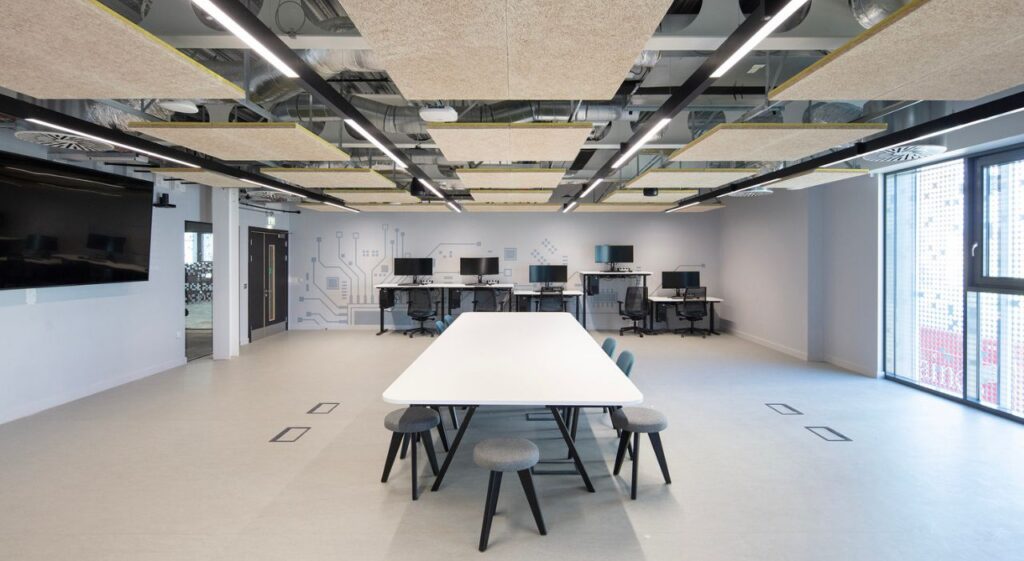
Facilities include a double-height motion capture and recording studio, robotics lab, stop motion studio, cyber security lab, gaming labs and computing labs, which all drive Teesside University’s mission to deliver an outstanding student experience.
Connectivity powers every corner of the building, with lighting, screens and cameras controlled remotely, enabling seamless content sharing, streaming and broadcasting from a central system.
Architecturally, the building is defined by a bespoke perforated aluminium veil, its stunning design symbolising “data glitches”. The façade provides solar shading, functions as public art and features programmable lighting.

Sustainability performance exceeds industry benchmarks. The all-electric building incorporates photovoltaic (PV) panels and air source heat pumps; it achieved an elite air-tightness result of 2.8 and secured BREEAM Outstanding. It now serves as a national template for sustainable higher education facilities.
Our approach to social impact is grounded in the belief that how we do business is just as important as what we do. We are committed to creating lasting, positive change by fostering stronger, more sustainable societies through every stage of construction.
The team focused on a long-term legacy through initiatives like the “Digital Forest” – involving planting 972 trees with the Tees Valley Wildlife Trust and partnering with Clean Slate Solutions to support ex-offender rehabilitation. Other activities included accommodating work placements, delivering careers workshops at schools and using local social enterprises such as Nuneaton Signs to generate wider economic benefits.
Share


Contact us
Get in touch to chat about your construction project.
